
Add mobility concerns, insurance questions, and installation logistics into the mix, and the decision gets overwhelming fast.
This guide reviews the top walk-in bath brands for 2026, breaks down real installed costs, and helps you figure out whether a walk-in tub fits your situation, or whether a therapeutic soaking tub might serve you better without the accessibility price tag.
Key Takeaways
- Walk-in baths typically run $4,000–$25,000+ installed, depending on brand and hydrotherapy features
- Kohler, American Standard, and Safe Step lead the 2026 market, each with distinct warranty and pricing strengths
- Ideal for mobility limitations, arthritis, or aging-in-place plans
- Not everyone needs a step-in door. Some buyers prefer a freestanding jetted soaking tub for relaxation without the wait
What Is a Walk-In Bath and How Does It Work?
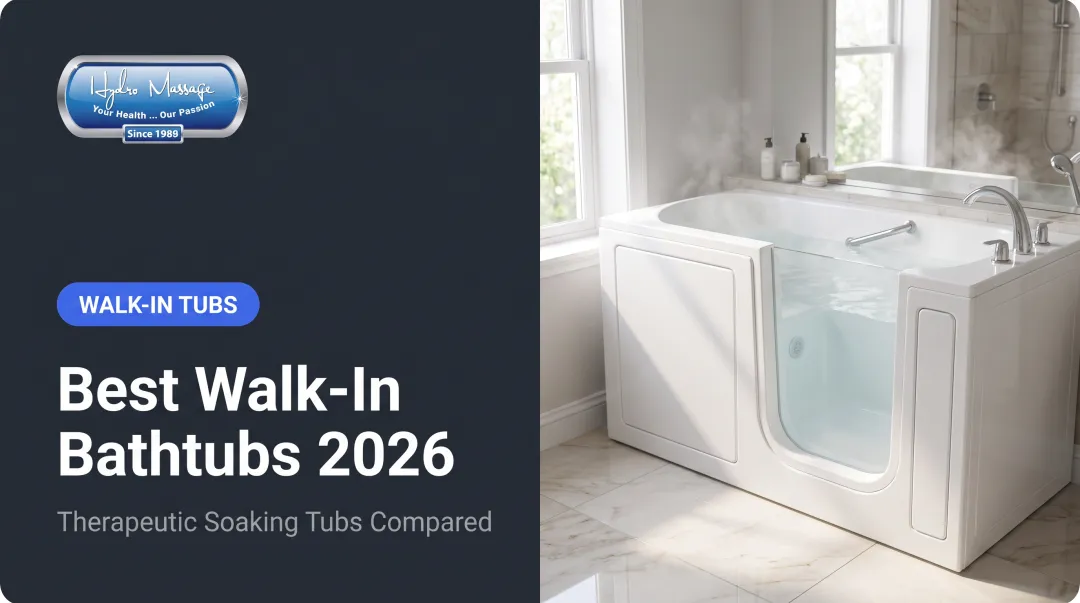
A walk-in bath is a bathtub with a watertight door built into the side, so you can step in at floor level instead of climbing over a high wall. Step-in heights vary by manufacturer, from Kohler's 3-inch threshold to MediTub's 5-inch entry.
Once inside, you sit on a built-in seat, close and seal the door, then fill the tub. When you're done, the water drains before you exit, since the door can't open while water sits inside.
Standard safety features include:
- Grab bars and handrails
- Slip-resistant flooring or seating
- Low, watertight entry doors
- Anti-scald temperature controls
Premium features on higher-tier models:
- Hydrotherapy water and air jets
- Chromotherapy and aromatherapy systems
- Heated backrests or seats
- Fast-fill and fast-drain technology

Who Benefits Most
Walk-in tubs are built for accessibility and fall prevention, not general relaxation. The CDC reports that more than 1 in 4 older adults fall each year, and falling once doubles your risk of falling again. That's the core case for a walk-in door.
If you're not managing a mobility limitation and simply want a therapeutic soak, a standalone jetted tub may be the better fit. You still get stress relief, better sleep, and pain relief—usually at a lower cost, and without waiting for the tub to drain before you can exit.
Top Walk-In Bath Brands Reviewed for 2026
Three brands dominate most 2026 walk-in bath shortlists. Here’s how Kohler, American Standard, and Safe Step compare on access, warranty, features, and price.
Kohler
Kohler's biggest selling point is its lifetime limited warranty paired with an industry-low 3-inch step-in. Standard units run roughly 60 x 32 x 38 inches, with smaller 36 x 32-inch models available for tight bathrooms.
Kohler builds in hydrotherapy and BubbleMassage air jets, fast drain/fill, and a heated backrest. One notable gap: the brand doesn't publish a wheelchair-accessible model, so buyers needing full transfer capability should look elsewhere.
American Standard
American Standard offers the widest catalog, spanning 60–70+ configurations. Its Liberation line carries a lifetime warranty on the door seal, plus 15 years on the acrylic shell and 10 years on components for premium models.
Premium units also include:
- 17-inch ADA-compliant seat
- 44 air/water jets
- 7-color chromotherapy
The tradeoff is price. Entry-level American Standard models tend to cost more upfront than comparable Safe Step or Kohler units.
Safe Step
Safe Step stands out for financing flexibility and an ozone cleaning system built into the jets, which the company markets as purifying water automatically. Its lifetime warranty covers the tub, door seal, and faucets, but only on units Safe Step installs itself.
Pricing tends to land competitively against Kohler and American Standard, particularly with promotional financing (Safe Step has advertised $0 down, 0% interest offers in select states through late 2026, subject to credit approval).
| Brand | Step-in height | Starting price | Warranty | Standout feature |
|---|---|---|---|---|
| Kohler | 3 inches | ~$9,000+ | Lifetime | Ultra-low threshold |
| American Standard | Not publicly stated | ~$10,000+ | Lifetime (door seal) | Widest model range |
| Safe Step | Not publicly stated | ~$8,000+ | Lifetime (installed units) | Ozone cleaning system |

Buyer feedback on the category is strong overall. According to a 2026 NCOA survey of walk-in tub buyers, 86% reported a positive or very positive impact on their mobility and independence, with only 1% reporting a negative experience.
Is a Walk-In Bath Worth the Money?
Value depends on three things: how limited your mobility is, how long you plan to stay in your home, and your budget—not the sticker price alone.
The safety case is strong. The CDC found the age-adjusted fall-death rate among older adults climbed from 64.7 per 100,000 in 2018 to 78.4 per 100,000 in 2024, a 21% jump. Older-adult falls also account for roughly 3 million emergency-department visits and 1 million hospitalizations annually.
The "wet wait" is the most common regret. ConsumerAffairs reports that fill time runs 6–8 minutes, and drain time can take up to 15 minutes. You sit in the tub, sometimes cooling water, until it's fully drained before you can open the door.
Resale value is murkier than most sites admit. NAR notes many agents still recommend keeping at least one conventional tub for buyer appeal, especially with young families. That said, NAR doesn't quantify a resale penalty for walk-in installs, and installed walk-in tubs (roughly $6,000–$14,000 per NAR) rarely make or break a sale.

Insurance coverage is limited:
- Original Medicare typically doesn't cover walk-in tubs as durable medical equipment
- Some Medicare Advantage plans offer modest home-modification allowances ($200–$2,000/year)
- VA HISA grants offer up to $6,800 for qualifying service-connected veterans, $2,000 otherwise
- Medically necessary improvements may qualify for a tax deduction under IRS Publication 502, though costs are reduced by any home-value increase
If you don't need the accessibility door, a standard therapeutic tub may be the better buy. Hydro Massage Products, an American manufacturer based in Aurora, Colorado, builds freestanding jetted soaking tubs for therapeutic use—no step-in door, no wet wait.
Their Combo, Air, and Hydro tiers deliver the same stress relief and pain relief benefits walk-in buyers often cite, at prices starting well below entry-level walk-in models.
What Is the Best Walk-In Bath for Elderly People?
There's no single "best" model. It depends on step-in height, seat width, and whether wheelchair transfer matters.
For most elderly users without wheelchair needs, two features matter most:
- Kohler's 3-inch step-in minimizes fall risk during entry
- Safe Step's ozone cleaning cuts weekly scrubbing for anyone who can't easily maintain a tub
For larger mobility needs, look beyond standard models:
- Ella's Transfer series (Transfer26 through TransferXXXL): L-shaped, barrier-free doors for wheelchair transfer, seat widths from 19 to 29 inches
- MediTub's 2953WCA and 3060WCA: built for wheelchair users at 29x53 and 30x60 inches
- MediTub's 2646 Series: 17-inch ADA seat with a 5-inch entry threshold
- Hydro Massage Products' R5030 Transfer and Tranquil ADA-style baths: U.S.-made transfer options for buyers who want domestic manufacturing
Before buying, loop in a caregiver or occupational therapist. Seat height and grab bar placement matter more than most spec sheets suggest. Someone assisting with transfers day-to-day will catch problems a brochure won't.
Walk-In Bath Costs and Financing Options in 2026
Most walk-in bath projects land in one of three installed price tiers:
- Entry-level: $4,000–$10,000 (basic soaker models, minimal jets)
- Mid-range: $10,000–$20,000 (hydrotherapy jets, upgraded seating)
- Premium hydrotherapy: $20,000–$33,000+ (full jet systems, chromotherapy, custom installation)
Installation often raises the final bill. Plumbing changes, electrical upgrades, and water heater capacity increases can add $500 to $8,000, depending on your home's existing setup.

Common financing paths:
- Manufacturer financing — many major brands offer promotional 0% or reduced-interest terms for 12 months, subject to credit approval
- VA HISA grants — up to $6,800 for qualifying veterans
- Medical tax deductions — expenses above 7.5% of adjusted gross income may qualify under IRS rules
- Medicaid HCBS waivers — available in select states; eligibility and prior authorization vary by state
What to Inspect Before You Buy Any Walk-In Bath
Brand shortlists are useful, but most long-term complaints trace back to four things no showroom display makes obvious. Take these questions to every manufacturer you are comparing.
Shell and floor construction. Every acrylic bath begins as a flat cast sheet heated to roughly 390°F and drawn over a mold, with fiberglass applied to the outside for strength. Many manufacturers economise with a sheet around 20% thinner and 200-300% less fiberglass. The saving is real for them, but a thin shell can feel like an eggshell, with a floor that flexes or squeaks as you step in. Ask for acrylic thickness and how the floor is reinforced. Hydro Massage uses some of the thickest cast acrylic available for baths and layers its floors with fiberglass and wood.
Plumbing that empties itself. The discharge people complain about in older jetted tubs is biofilm from water left standing in the lines. Ask whether the tubing is arched above the jet line. Hydro Massage arches its tubing 3-10 inches above the jets, uses smooth-wall non-toxic FDA-recipe tubing, and runs up to 40% less surface plumbing, with a drain-down port on the back jets and an optional O3 oxygen sanitation system rated to kill up to 99.9% of bacteria in the bath.
Access to the pump. This is the question almost nobody asks and everybody eventually regrets. If a pump fails in a bath with no access panel, a plumber has to disconnect the drain and turn the tub upside down to reach it, then come back to reseal it afterward, commonly $600-$900 in labor before the replacement pump. Every Hydro Massage therapeutic water massage bath includes an in-tub access panel as standard.
Labor, not just parts. Many baths carry a short parts warranty and no labor coverage at all, which can mean a shipped component and no one to fit it. Hydro Massage offers a limited lifetime warranty on its pumps and on the structural integrity of the bath, and has recorded service-related issues on under 1% of baths over more than four decades.
If a step-in door is not essential for your situation, a freestanding jetted bath built to the same standards gives you the hydrotherapy without the wet-wait cycle.
Frequently Asked Questions
Is a walk-in bath worth the money?
It depends on your mobility needs, budget, and how long you'll stay in the home. Safety gains are real, but the wet-wait tradeoff and lack of insurance coverage mean it isn't a universal yes.
What is the best walk-in bath for elderly people?
Low step-in height, wide seating, and models from Kohler or Safe Step are commonly recommended. For wheelchair users, Ella's Transfer series or MediTub's wheelchair-accessible models are better fits.
Does Medicare cover walk-in tubs?
Original Medicare generally doesn't classify walk-in tubs as durable medical equipment, so it doesn't cover them. Some Medicare Advantage plans offer limited home-modification benefits instead.
How long do walk-in tubs typically last?
Most last 10–15 years with proper maintenance, according to ConsumerAffairs. Jet system upkeep and door seal care have the biggest impact on lifespan.
Are walk-in tubs prone to leaking?
Quality brands use watertight door seals, but leaks typically stem from installation errors, worn gaskets, or door misalignment over time, not the core design itself.
What's the difference between a walk-in tub and a therapeutic soaking tub?
Walk-in tubs prioritize accessibility with a step-in door for people with mobility limitations. Therapeutic soaking tubs, like those from Hydro Massage Products, focus on wellness benefits—relaxation, pain relief, and better sleep—without an accessibility door or wet-wait cycle.
How do I check the build quality of a walk-in bath before buying?
Ask for the acrylic thickness, how many layers of fiberglass reinforce the shell, whether the floor is backed with wood, whether the tubing is arched above the jets so it drains, and whether the pump can be reached through an access panel. A manufacturer that builds its own baths can answer all five. A reseller usually cannot.
Does a walk-in bath warranty cover labor?
Often not. Many warranties cover parts for a limited period and exclude labor entirely, so you may receive a component with no one sent to install it. Hydro Massage covers its pumps and the structural integrity of the bath under a limited lifetime warranty, and its baths include an access panel so servicing does not require removing the tub.