
The numbers back this up. The CDC reports that more than 1 in 4 adults age 65+ falls each year, and about 37% of those falls cause an injury serious enough to need medical treatment. Bathroom transfers are among the riskiest moments in a daily routine.
The good news: solutions exist for nearly every mobility level and budget. This guide covers wheelchair accessible bathtubs, walk-in tubs, transfer benches, and ADA-inspired safety standards. We'll break down real costs, funding realities (including what Medicare actually covers), and how to pick the right option for your situation.
Key Takeaways
- Accessible bathtubs reduce fall risk and help people with limited mobility bathe independently
- Options range from low-threshold walk-in tubs to transfer baths and freestanding jetted models
- Grab bars, non-slip surfaces, and proper clearance matter more than the "accessible" label alone
- Medicare rarely covers tubs; Medicaid waivers and VA grants may help instead
- The right choice depends on transfer ability, bathroom layout, and caregiver support
What Makes a Bathtub Wheelchair Accessible
Not every "walk-in tub" works for a wheelchair user. True accessibility means:
- Low or zero-threshold entry — a door that opens for step-through access instead of climbing over a wall
- Wide door openings — enough clearance for a safe, unhurried transfer
- Transfer-friendly seating — a seat positioned to match wheelchair height
- Slip-resistant surfaces — inside the tub and on the surrounding floor
"Senior-friendly" isn't the same as wheelchair accessible. A senior-friendly tub might lower the step-in height for someone who can still stand and pivot. A wheelchair user typically needs that, plus a clear approach path and enough floor space to position the chair right next to the tub for a lateral or assisted transfer.
Essential Safety Features
Look for these non-negotiables:
- Grab bars rated for real weight-bearing use
- Built-in or add-on seating at the correct height
- Handheld showerheads with long hoses
- Anti-scald technology (water capped around 120°F)
- Step-in height in the 2-6 inch range, depending on the model

Why Bathroom Layout Matters as Much as the Tub
A perfect tub in a cramped bathroom still fails the user. Door width, floor space, and turning radius determine whether a wheelchair can even reach the tub. Some buyers invest in a premium accessible tub only to discover their bathroom door is too narrow for a wheelchair to enter comfortably.
Therapeutic Benefits Beyond Access
Hydrotherapy jets and air massage support recovery from surgery, ease arthritis pain, and improve circulation. For many wheelchair users, those benefits matter as much as the transfer and safety features themselves.
Types of Wheelchair Accessible Bathtubs and Alternatives
There's no single "best" option. Here's how the main categories compare:
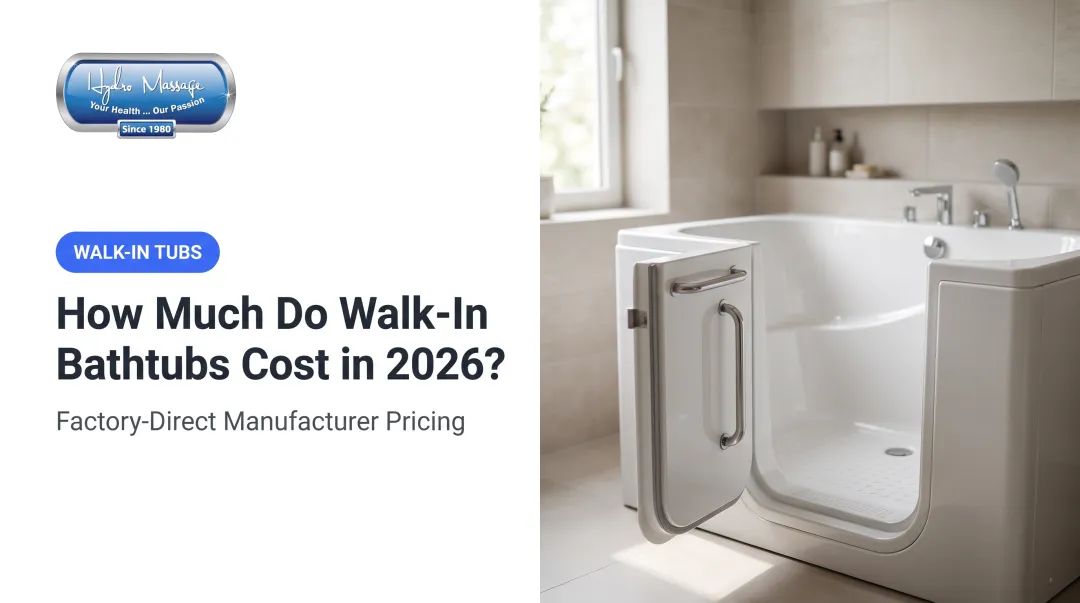
- Walk-in tubs — Low-threshold door and built-in seat. Best when the user can bear some weight and transfer independently, even if slowly.
- Transfer or roll-in systems — Sliding benches move a wheelchair user from chair to tub with minimal lifting. Often the safer pick when standing isn’t possible.
- Freestanding jetted or soaking tubs — Full-immersion hydrotherapy tubs paired with external transfer benches and grab bars. Hydro Massage Products builds American-made freestanding models (including the Rosabella and Oasis series) that support this setup.
- Walk-in showers and shower-tub combos — Standing or seated showering instead of full immersion; often a simpler renovation.
- Portable and inflatable tubs — Lower-cost, non-permanent options for caregiver-assisted bathing when someone cannot safely transfer to a conventional bath or shower. Useful for renters or short-term recovery—not a substitute for independent access.

Is There a Freestanding Walk-In Tub? Exploring the Options
This question comes up constantly, and the honest answer is: not exactly, but you can get close.
Most walk-in tubs are built-in units, installed against a wall with plumbing connections designed for that specific footprint. Freestanding jetted tubs are a separate category entirely. They're not walk-in by design, but you can adapt them with external transfer aids like benches or grab bars mounted nearby.
When does a freestanding therapeutic tub make more sense than a built-in walk-in tub?
- You want a design-forward centerpiece for a bathroom remodel
- Hydrotherapy and wellness matter as much as accessibility
- You have the floor space for a transfer bench setup
- You want more flexibility in tub shape, size, and jet configuration
Hydro Massage Products' freestanding lineup includes the Oasis (66"–72" lengths), Ovale, Tahoe, and Rosabella series. Jet setups range from 7 hydro jets up to 43 combined hydro-and-air jets.

Their Custom Build & Price tool lets buyers set size, jet type, and finish around real needs. For example, 59"–66" tubs generally suit someone 5'–5'6" tall.
If accessibility comes first over design, the dedicated Tranquil walk-in and R5030 transfer bath lines are built for that job.
ADA Compliance and Safety Standards
Here's something many buyers don't realize: no residential bathtub is technically "ADA certified." The ADA applies mainly to public and commercial spaces.
ADA.gov confirms Title III does not apply to strictly residential facilities, though public accommodations within residential buildings can still be covered. Even so, ADA guidelines remain an excellent safety benchmark for a home bathroom.
Key ADA-inspired specs worth following:
| Feature | ADA benchmark |
|---|---|
| Seat height | 17-19 inches above the floor |
| Grab bar diameter | 1.25-2 inches, rated for 250 lbs of force |
| Clear floor space | At least 30 x 48 inches |
| Grab bar wall clearance | 1.5 inches from the wall |

The ADA doesn't actually specify a bathtub threshold height. The half-inch rule people often quote applies to shower compartments, not tubs. Market benchmarks for walk-in tubs run closer to 3 inches, with true wheelchair roll-in thresholds as low as 0.5 inch.
Manufacturers often design toward these ADA-inspired criteria even without formal certification. When shopping, ask directly about seat height, grab bar weight ratings, and clearance dimensions rather than trusting an "ADA-style" label at face value.
Cost, Funding, and Medicare Coverage
Let's address the question everyone asks first: does Medicare pay for accessible bathtubs?
Generally, no. According to NCOA, Original Medicare Parts A and B don't cover walk-in tubs because they're classified as home modifications rather than durable medical equipment (DME). Medicare's DME definition covers items like wheelchairs and walkers, not bathroom fixtures.
Other funding paths worth exploring:
- Medicaid HCBS waivers — state-specific programs sometimes covering "environmental accessibility adaptations"
- VA housing grants — Specially Adapted Housing (SAH) and Special Home Adaptation (SHA) grants for eligible veterans, with FY2026 maximums reaching $126,526 and $25,350 respectively
- State Assistive Technology programs — vary widely by state
- Manufacturer financing plans — check directly with the manufacturer for payment options
What You'll Actually Pay
Costs vary by product type:
- Transfer benches: Least expensive option, typically a few hundred dollars
- Walk-in tubs: Pricing swings with features, door/access design, and installation scope
- Premium freestanding jetted tubs: Higher equipment cost, though some models use standard connections and avoid major plumbing changes
Hydro Massage Products' accessible lineup falls in these ranges:
- Tranquil accessible models: about $5,247–$10,271 depending on configuration
- R5030 Transfer Bath: $7,987–$12,526
- Broader freestanding jetted lineup: from about $1,595 for simpler configurations

Always request itemized quotes for both equipment and installation. Those two line items can differ significantly.
How to Choose the Right Accessible Bathtub for Your Needs
Start with an honest assessment, not a shopping list. Ask these questions first:
- Can the user bear weight during a transfer, even briefly? This determines whether a walk-in tub or a transfer/slide system makes more sense.
- What's the bathroom's actual floor space? Measure door width and turning radius before falling in love with a specific tub.
- Are there plumbing constraints? Some installations require significant electrical or plumbing work; others don't.
- Is chronic pain or recovery part of the picture? If so, a jetted tub with hydrotherapy can serve double duty: accessibility plus genuine therapeutic benefit.
A quick self-check: If someone needs help transferring every time, a transfer bench or R5030-style slide-in system is usually safer than a walk-in tub that requires standing balance.
Because every bathroom and every user's needs are different, a phone consultation with a manufacturer often beats guessing from a website.
Hydro Massage Products, for instance, connects buyers with an experienced designer who walks through wellness goals, bathroom configuration, and accessibility requirements before recommending a specific model. That might be the R5030 Transfer Bath or a freestanding option paired with external aids.
Comfort and Serviceability in an Accessible Bath
Accessibility features get someone safely into the bath. Comfort engineering and service access decide whether they keep using it.
Geometry decides whether bathing stays independent. Water deep enough to cover the upper chest and shoulders keeps a soak warm without repeated topping up. Ergonomically placed armrests let elbows rest down and hands rest up, which matters a great deal for anyone with limited shoulder strength, and is very different from gripping a high tub rim. A back reclined between 115 and 130 degrees supports the whole spine rather than forcing an upright seated position. Hydro Massage builds these into its Comfort Package, available on most models; verify which features are included on the model you are considering.
Jet placement matters more than jet count. For chronic pain, relief depends on the jets reaching the area that actually hurts. Many baths concentrate jets around mid back. Hydro Massage therapeutic back systems cover neck, shoulders, mid back, lower back and feet, with each jet delivering a dual pulsating stream over roughly a 2-inch area, designed to target trigger points, support circulation and relax tense muscles.
Service access is an accessibility issue. If the pump fails in a bath with no access panel, the drain has to be disconnected and the bath turned upside down, which for a fitted accessible installation can mean losing bathing access for days and $600-$900 in labor before the pump. Hydro Massage therapeutic water massage baths include an in-tub access panel as standard, with an EZ Connect drain system recommended for installation.
Ask for help before ordering, not after. Bathroom layout, doorway and delivery access, electrical requirements, plumbing and body fit all need checking against the specific person who will use the bath. Getting that wrong is expensive to discover after installation, which is why we work through it with buyers beforehand. See our ADA-compliant bathtub options and safe bathing models for configurations that suit different mobility needs.
Frequently Asked Questions
Does Medicare pay for bathtubs?
No. Medicare Parts A and B classify walk-in and accessible tubs as home modifications, not durable medical equipment, so they generally aren't covered. Check Medicaid waivers or VA grants instead.
What are the best baths for people with disabilities?
Walk-in tubs work well for those who can transfer independently. Transfer/slide-in systems suit those who need full assistance. Freestanding jetted tubs paired with transfer benches add therapeutic value.
What is a good portable bathtub for someone with a disability?
Inflatable or portable tubs work best for caregiver-assisted bathing when a person can't safely transfer to a standard tub. They're not designed for independent wheelchair use.
Is there a freestanding walk-in tub?
Not exactly. Walk-in tubs are typically built-in units. Freestanding jetted tubs exist separately and can be combined with external transfer benches and grab bars for a similar accessible experience.
What can you use instead of a bathtub?
Walk-in showers, shower-tub combos, and bath lifts are common alternatives. These often suit people who prefer standing or seated showering over full immersion bathing.
Can a bathtub be ADA compliant?
Technically, ADA rules apply to commercial spaces, not private homes. However, residential tubs can follow ADA-inspired specs like 17-19 inch seat height and proper grab bar placement for real safety benefits.
What makes an accessible bathtub comfortable, not just safe?
Depth, armrest placement, back angle and leg room. Water that covers the upper chest and shoulders stays warm, ergonomic armrests support the arms without lifting the shoulders, and a back sloped between 115 and 130 degrees lets the bather lay back instead of sitting upright. Safety features control risk; these four decide whether the bath is pleasant enough to use daily.
Can the pump be serviced without removing an accessible tub?
Only if the bath has a service access panel. Without one, a plumber must disconnect the drain and turn the tub over, which is disruptive in a fitted accessible bathroom and typically costs $600-$900 in labor. Hydro Massage therapeutic water massage baths include an in-tub access panel as standard.